Composition
Using Perspective and Angle to Change How a Photo Feels
Learn how photography perspective and angle change mood and story, with low-angle, high-angle, and eye-level examples for pets, buildings, and food.
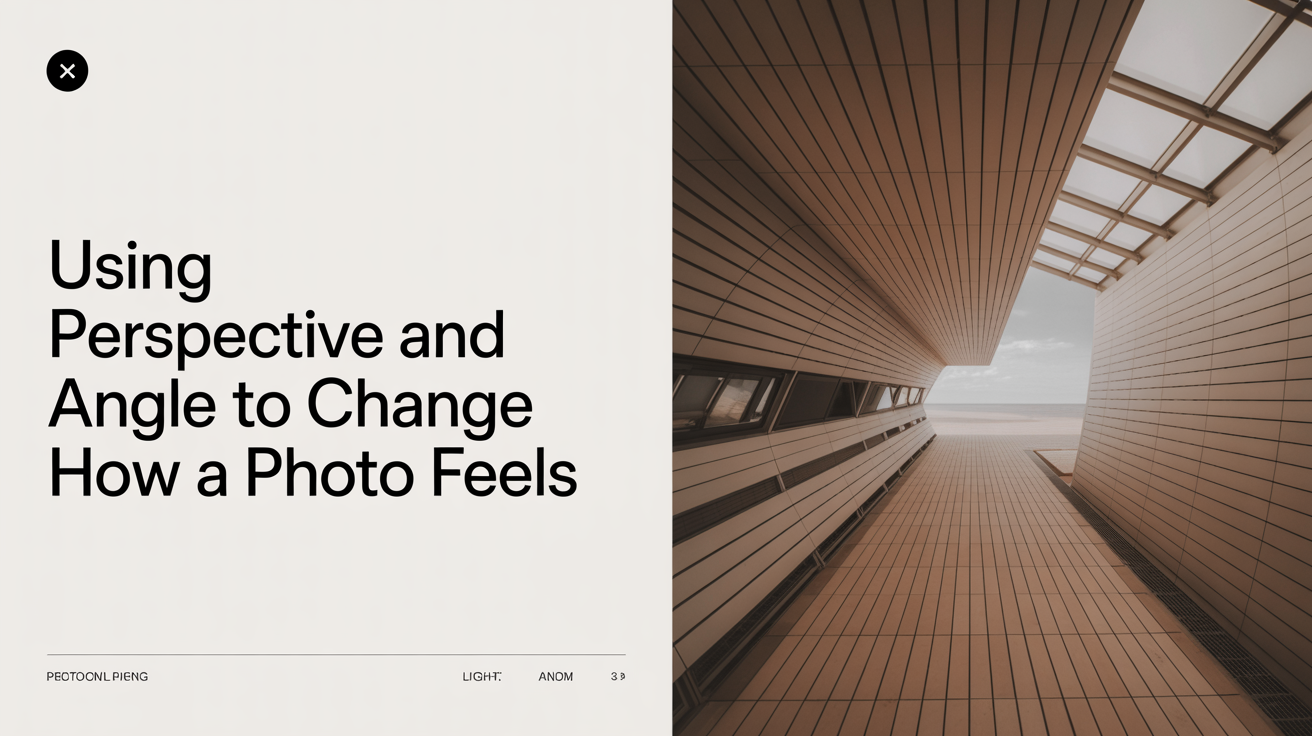
Look back through your camera roll and there's a good chance almost every shot was taken from the same spot: standing up, camera at chest or eye height, pointed straight at the subject. It's the angle your body naturally lands in, so it's the angle most beginners shoot from without ever deciding to. The problem is that photography perspective and angle do more work in a photo than almost any other single choice you make. Change where the camera sits relative to your subject and the picture changes what it says, even if nothing else in the scene moves.
This isn't about finding a gimmick angle for its own sake. A camera three feet off the ground tells a different story than one held above your head, and the goal is to pick the height on purpose instead of by default.
How Photography Perspective and Angle Change the Story
A photograph doesn't just record a subject, it records a relationship between the camera and that subject. Standing above something and looking down places the viewer in a position of control over it. Standing below something and looking up places the viewer beneath it, which can read as respect, intimidation, or awe depending on what's in the frame. Eye level is neutral. It says "we are equals," which is exactly why it's the default and also why it can feel flat when repeated shot after shot.
This isn't invented psychology, it's the same reason a coach kneels to talk to a child, or a judge sits above a courtroom. Once you start noticing how camera angle affects a photo, you see the pattern everywhere: hero shots in ads are almost always low angle, and surveillance-style images are almost always high angle.
Eye Level: The Angle You Already Know
Eye level isn't a bad angle, it's just an overused one. It works well when you want a photo to feel honest, like a portrait where the viewer meets the subject's gaze directly, person to person. The trouble starts when it's the only angle you ever try. A whole gallery of eye-level shots can look competent but interchangeable, because the viewer's relationship to every subject is identical.
Use eye level deliberately for portraits and for any subject where you want connection rather than drama. Just don't let it be a habit you never question.
Shooting From a Low Angle
Getting the camera below your subject and tilting up, sometimes called worm's eye view photography, makes things look bigger, taller, and more imposing. A dog photographed from a low angle looks powerful and alert instead of small and cute. A building shot from ground level with the camera tilted toward the roofline gains height and drama that a straight-on shot from across the street never captures. Even a plate of food benefits: get the lens close to table height and a stack of pancakes has real presence, with syrup pooling toward the camera instead of sitting flat in the frame.
Low angles also tend to simplify backgrounds. Point a camera upward at a dog in a park and you often trade a busy patch of grass and parked cars for open sky, which is a second reason low angles read as clean and dramatic at the same time.
Getting Low Without Wrecking Your Gear
A few habits keep this angle from turning into a repair bill:
- Check the ground before you kneel or lie down. Wet grass, gravel, and mud are the usual suspects for a scraped lens barrel or a dead camera.
- Use a rain cover, a jacket, or a plastic bag under the camera if the ground is damp.
- For pets, get down to the animal's actual eye level rather than just "lower than usual." A slight tilt below their eye line reads as dramatic; going too far below can look awkward.
- If your camera has a flip-out or tilting screen, use it, so you don't need to lie flat on your stomach to see the shot.
- Brace your elbows on your knees or the ground. Low angles mean less stable positions, and a shaky low-angle shot cancels out the drama with blur.
For animals specifically, pair this with the posing and patience tips in a beginner's guide to photographing pets.
Shooting From a High Angle
Bird's eye view photography does the opposite job. Looking down at a subject shrinks it, both literally and emotionally, and can make it look smaller, more vulnerable, or simply reveal information a normal vantage point can't, like the layout of a table setting or a pattern in a crowd.
Food photography leans on high angles constantly. Shooting straight down on a full breakfast spread, a charcuterie board, or a bowl of pasta shows the whole composition of colors and shapes at once, the way you'd see it walking up to the table. Street photography uses high angles for the opposite reason: shooting down from a balcony or a set of stairs turns people into shapes and patterns rather than individual portraits, which changes a busy street from chaotic to graphic.
High angles are also a quiet trick for controlling backgrounds. Point a camera down and the ground itself, a table, a sidewalk, a rug, becomes the background, usually far less cluttered than whatever is happening at eye level.
Getting High Without Taking a Risky Climb
A high angle doesn't require climbing something risky. Standing on a stable chair, shooting from a staircase landing, or holding the camera up on a fully extended strap with a wide-angle lens gets you most of the effect. If you do use a stepladder or ledge, check the surface first, don't lean past your balance point, and give yourself extra margin on a windy day. No photo is worth a fall.
How Angle Interacts With Background Clutter
Angle and background are more connected than most beginners realize. A cluttered eye-level shot in a living room, toys, cables, a pile of laundry, can often be solved without moving a single object, just by changing the camera's height. Shoot low and the background might become a clean wall or open doorway. Shoot from above and the background becomes the floor.
Try this before moving furniture or asking someone to tidy a room for a shot. Half the time, the clutter problem is really an angle problem. It's the same instinct behind using foreground elements to control what the eye notices first, covered in creating depth with foreground and background.
A Simple Three-Angle Process
The fastest way to build a feel for this is to force yourself to try more than one angle every time, even when the eye-level shot looks fine. Here's a process that takes under a minute once it's a habit:
- Shoot the obvious eye-level shot first. Get the safe photo in the bag so you're not anxious about "missing the shot" while you experiment.
- Drop low. Crouch, kneel, or get the camera near the ground and tilt up at the subject. Check the background changed, not just the subject's size.
- Get high. Stand on something stable, hold the camera overhead, or find a nearby high spot and shoot down.
- Compare on the spot. Look at all three on your camera screen or phone before you move on. You're not judging which is "best" in the abstract, you're judging which one matches the feeling you actually want for that subject.
Do this for a month on ordinary subjects around the house, a pet, a coffee cup, a doorway, and camera height stops being an afterthought. You'll start seeing the right angle before you even lift the camera.
This pairs well with basic framing decisions too. Once you've picked an angle, the rule of thirds and when to break it is the natural next stop, since angle and framing solve different problems but work best together. The same layered thinking applies to bigger, static subjects: photographing architecture and buildings leans heavily on low-angle drama for the reasons covered above.
Frequently Asked Questions
Does a low angle always make a subject look better?
No. A low angle makes a subject look larger and more dominant, which suits pets, buildings, and anything you want to feel powerful. It can look strange on a portrait shot from directly below the chin, since it exaggerates features unflatteringly. Check the result before assuming lower is automatically stronger.
What's the difference between a high angle and a bird's eye view?
They're on the same spectrum. A high angle is any shot where the camera looks down at the subject. A true bird's eye view is the extreme end, shooting straight down so the subject reads flat, like a map. Food and flat-lay photography usually use a true bird's eye view, while street or portrait high angles are more moderate.
Do I need special equipment to shoot low or high angles?
Not for most beginner work. A tilting screen helps for low angles so you're not lying on the ground to see your composition, and a fully extended strap can get you a high angle without a ladder. A small stool and a folded towel or rain cover are the only real accessories worth having.
How do I know which angle is right for a subject?
Try more than one before you decide. Use the three-angle process above: shoot eye level, then low, then high, and compare side by side. Over time you'll notice patterns, pets and buildings usually reward low angles, food and crowded scenes reward high angles, but the only reliable way to know for a specific subject is to check.
Can changing angle fix a bad background?
Often, yes. Angle changes what's directly behind your subject, so a cluttered eye-level background can turn into open sky from a low angle or a clean floor from a high angle. It won't fix every problem, but it's worth trying before moving objects or asking people to tidy a room for a photo.