Composition
How to Create Depth in a Photo (Foreground and Background)
Learn how to create depth in photography using foreground, middle ground, and background layers, low angles, and simple composition tricks.
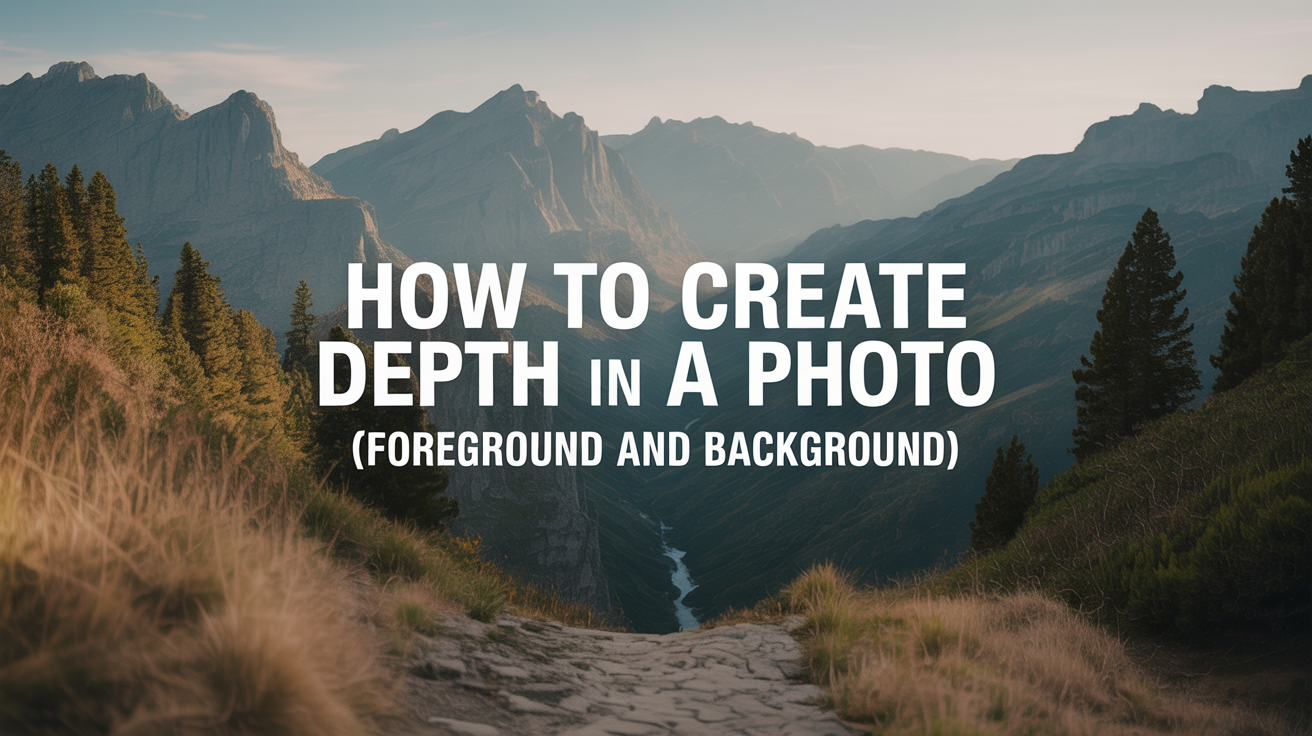
Flat photos are easy to take. You point the camera, press the shutter, and get a record of what was there. But the images that stop people mid-scroll share something different: they feel three-dimensional. They pull you in. That sense of space is called depth, and you can learn to build it deliberately.
The good news is that creating depth in photography doesn't require fancy gear or years of experience. It mostly requires thinking about what you put in three distinct zones of your frame.
The Core Idea: Foreground, Middle Ground, and Background
Every photograph has layers, even if you don't think about them. The foreground is the area closest to your lens. The middle ground is the zone further back where your main subject often lives. The background is everything behind that, stretching to the horizon or the back wall.
Most beginners ignore the foreground completely. They walk up to a scene, aim at the subject, and shoot. The result is a flat image with no sense of distance. The fix is simple: find something interesting to put close to your lens.
Say you're photographing a mountain. Without a foreground, you get a snapshot. Step back and crouch down near some wildflowers, placing them in the lower third of the frame, and suddenly the photo has three layers. Your eye travels from the flowers, across the valley, up to the peak. That journey is depth.
This layered approach works alongside other compositional tools. If you've already explored the rule of thirds, you'll notice that placing foreground elements in the lower third leaves the upper two-thirds free for your middle ground and background to breathe.
Six Techniques to Add Depth to Photos
Here is a numbered list you can run through the next time you set up a shot:
-
Get low and use a wide angle. Crouching or even lying on the ground exaggerates the size of foreground objects, which amplifies the sense of distance to everything behind them. A wide lens (roughly 24mm to 35mm on a full-frame camera) stretches perceived depth even further, making near things appear larger and far things smaller.
-
Use overlap deliberately. When objects at different distances overlap in the frame, your brain reads one as closer and one as farther. A branch crossing in front of a building, a person partially hidden behind a tree, a rock partly obscuring a path: these overlaps tell the viewer there is real space between the elements.
-
Include leading lines. Roads, rivers, fences, shadows, and shorelines naturally pull the eye from the foreground into the distance. They are one of the most reliable ways to create depth in photos. If you want to dig deeper into this idea, our guide on leading lines walks through the technique step by step.
-
Shoot through something in the foreground. Framing your subject through leaves, a doorway, a gap in a fence, or an archway adds depth because your eye understands the foreground frame is closer than the subject inside it. This technique also adds a natural border that focuses attention. The article on framing in photography covers this approach in detail.
-
Use atmospheric perspective. This is the effect of haze, mist, or pollution in the air making distant objects appear lighter, bluer, and less sharp than close ones. It's one of the main ways our eyes read distance in the real world. On foggy mornings or during the golden hour when dust catches the light, you can capture this naturally. Even on clear days, distant hills and mountains often show a faint blue haze compared to the sharp foreground. Including objects at multiple distances makes this natural haze more visible and more useful.
-
Try selective focus vs. deep focus. Selective focus means using a wide aperture (a low f-number like f/1.8 or f/2.8) so your subject is sharp and the foreground or background goes soft. That blur, called bokeh, signals depth because your brain associates sharpness with nearness. Deep focus is the opposite: a narrow aperture (f/8 or higher) keeps everything from the foreground to the horizon sharp, letting the viewer explore all three layers. Neither is better. They just create different kinds of depth.
Scale Cues: Let Size Tell the Story
One underused trick for adding depth to photos is scale. When a known object appears small in the frame, we read it as distant. When the same type of object appears large, we read it as close.
Put a person in the far distance of a landscape photo, barely visible against the mountains, and the mountains immediately feel enormous. Put your hand or a camera bag close to the lens, filling the lower corner, and the scene behind it feels far away. You are using familiar sizes as reference points to teach the viewer how much space the photo contains.
This matters even indoors. A wide shot of a room with a chair in the foreground, a table in the middle ground, and a window in the background gives the viewer three anchors at different depths, and the room suddenly feels larger.
Practical Tips for Beginners
A few things that help when you're first practicing this:
Walk around before you shoot. Most beginners lock in on a subject and shoot from wherever they happen to be standing. Instead, spend two minutes exploring. Look for foreground options: rocks, plants, puddles, architectural details. Move low, move high, move left. The single best foreground element might be three steps to your right.
Check all three layers before you press the shutter. Once you've set up, scan the frame deliberately. Foreground: is there something interesting up close? Middle ground: is your subject well-placed? Background: is there clutter you can reframe to remove, or a nice clean sky you should include more of?
Don't force it. Sometimes a scene has great depth naturally and sometimes it doesn't. A close-up portrait doesn't need layers. A minimalist flat-lay is intentionally flat. Depth is a tool, not a rule.
Frequently Asked Questions
Do I need a special lens to create depth in photos?
No. You can create depth with any lens. A wide-angle lens exaggerates depth by making foreground elements appear larger relative to the background, which is why landscape photographers often favor them. But a 50mm or even a short telephoto can show depth through overlap, layering, and selective focus. The techniques matter more than the lens.
What's the easiest way to start adding depth?
Find a foreground element. That one change, crouching down near something close and including it in the lower part of the frame, transforms most flat images immediately. Start there before worrying about atmospheric perspective or lens choice.
Does aperture affect how much depth a photo shows?
Yes, in two ways. A wide aperture (low f-number) blurs backgrounds and sometimes foregrounds, signaling depth through selective focus. A narrow aperture keeps everything sharp, which lets the viewer see all three layers in detail. Both approaches work. The choice depends on whether you want the viewer to explore the whole scene or focus on one sharp subject against a soft background.
What is atmospheric perspective, exactly?
Atmospheric perspective is the way particles in the air (moisture, dust, pollution) scatter light and make distant objects look paler, bluer, and hazier than nearby objects. Painters have used it for centuries to suggest distance. In photography, you capture it rather than paint it, and it's most visible on humid days, in mountain ranges, or when shooting at dawn and dusk. Including objects at multiple distances makes this natural phenomenon more visible in your frame.
Can I add depth to indoor shots?
Absolutely. The same principles apply. Look for something to place close to the camera, position your subject in the middle zone, and make sure the background has some interest or at least doesn't compete. Shooting from a low angle at a table, for example, lets you include the surface in the foreground, the items on the table in the middle, and the room or a window behind them. Even a simple change like stepping back and using a chair as a foreground frame can open up an otherwise flat interior shot.