Composition
Framing in Photography: Using Natural Frames
Learn how to use doorways, windows, branches, and other natural frames to add depth and focus to your photos.
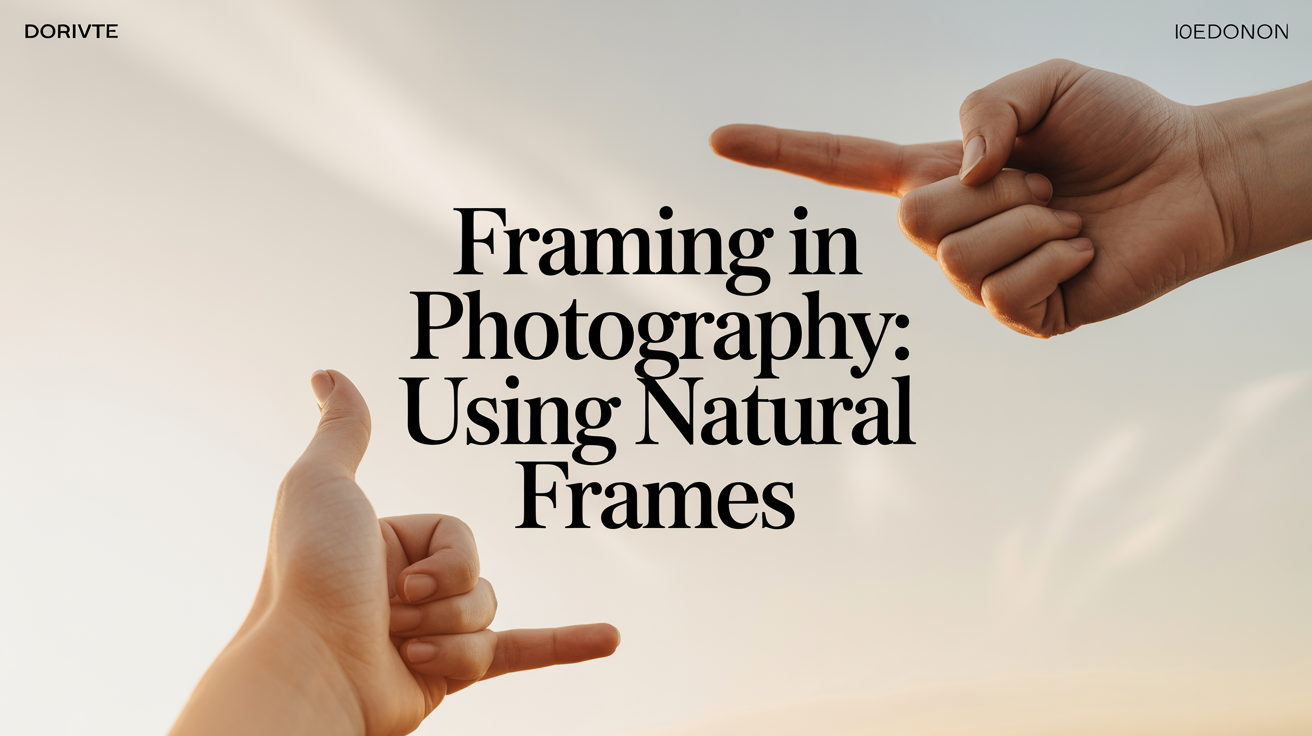
Your camera's viewfinder is already a frame. But inside that frame, you can place another one. This technique, called framing in photography, is one of the most satisfying compositional tools a beginner can learn. It costs nothing, works in almost any location, and immediately makes your images feel more intentional.
What "Frame Within a Frame" Actually Means
The idea is simple: you use something in your scene to surround, or partially surround, your main subject. That surrounding element becomes a secondary frame inside the rectangular frame of your photo. Think of a portrait taken through a stone archway. The arch borders the person, drawing your eye straight to them.
That is the core payoff. When a viewer looks at your photo, their eye naturally follows enclosed shapes toward what is inside them. You are essentially giving the viewer a visual path that says "look here." It feels like a discovery, which is far more engaging than a subject floating in an empty middle of the frame.
This is related to other composition principles worth exploring. The rule of thirds helps you place that subject once you have chosen your natural frame, and leading lines often work hand-in-hand with frames by pulling the eye through a doorway or tunnel toward the background.
Where to Find Natural Frames

Natural frames are everywhere once you start looking for them. The word "natural" here just means they already exist in the environment. You did not bring a prop or build anything. You simply noticed something and positioned yourself so it bordered your subject.
Here are ten reliable places to look:
- Doorways and doorframes -- the most common and reliable option. Open a door partway, shoot through it, and the door and frame become a border.
- Windows -- especially from inside a building looking out, or from outside looking in. A window naturally isolates whatever is on the other side.
- Archways and tunnels -- stone arches, brick tunnels, covered bridges. They create a strong oval or circular frame that draws the eye powerfully.
- Tree branches and foliage -- hang low branches in the foreground and your subject sits below them. Works well for landscapes and portraits outdoors.
- Rock formations -- two boulders on either side, or a gap in a cliff face, can frame a distant scene beautifully.
- Shadows -- a shadow cast by a doorway or a gap in a fence can frame light falling on your subject. This is subtle and requires good observation.
- Overhanging rooftops or eaves -- shoot from under a porch or awning, and the edge of the roof cuts across the top of your frame.
- Fences and gates -- a wrought-iron gate swung open, or gaps between fence boards, can surround a subject behind them.
- Hands, arms, and bodies -- in portrait work, one person can frame another. A hand on a shoulder, arms around someone.
- Vehicles and machinery -- car windows, holes in equipment, or the opening of a boat cabin can all frame a subject.
Foreground Frames Add Depth
One reason framing in photography works so well is that it separates your image into layers: foreground (the frame itself), midground (often empty space), and background (your subject). This layering gives a two-dimensional photo the feeling of three-dimensional depth.
To get this effect, you typically place the frame element close to your camera and let your subject sit farther away. A doorway at arm's length, a subject across a courtyard. The spatial separation between them does the work.
You can choose how sharp the frame itself should be. If you shoot at a wide aperture (a low f-number like f/1.8 or f/2.8), the nearby frame will blur into a soft, out-of-focus border. This keeps all the viewer's attention on the sharp subject while still hinting at the frame's shape. If you stop down to a smaller aperture (f/8 or higher), both the frame and the subject stay sharp, which suits architectural or landscape photos where the frame itself is part of the story.
Neither choice is wrong. It depends on what you want the viewer to feel. Blurry foreground frame: intimate and dreamy. Sharp foreground frame: structural and grounded.
Avoiding Frames That Distract
Not every possible frame is a good one. The goal is to guide the viewer's eye toward your subject. If the frame itself is too complex, too bright, or too busy, it steals attention instead of directing it.
Watch for these problems:
- A bright patch of sky inside a dark arch will pull the eye away from your subject if the subject is underexposed compared to that patch.
- Branches that cut across your subject's face rather than bordering around it are distracting.
- Frames that are only partial on one side, with nothing on the other, often look accidental rather than intentional.
The simplest test: squint at your preview or viewfinder. Where does your eye land first? If it lands on the frame before the subject, the frame is too dominant. Adjust your position, your exposure, or your depth of field until the frame feels like a border, not the star.
Speaking of simplicity, negative space pairs well with framing. Keeping the area inside the frame clean and uncluttered lets the framing composition do its job without competition.
A Simple Exercise to Try Today
Go to any doorway in your home or neighborhood. Stand outside and point your camera through the opening at something about ten feet inside. Shoot at two different apertures: wide open and stopped down. Then move closer to the doorway so it fills more of your frame, and shoot again.
You will end up with four images from one location. Compare them. Notice how the depth changes, how the door's sharpness changes, and which version draws your eye most cleanly to the subject inside. That comparison teaches more than any description can.
Once doorways feel comfortable, start looking for frames on your next walk. Windows in old buildings, gaps between trees, overpasses, cave openings. The habit of looking for frames changes how you see a scene before you raise the camera.
Frequently Asked Questions
Does the frame have to completely surround my subject?
No. A partial frame, like branches along the top and one side, still guides the eye effectively. Complete enclosure is stronger and more graphic, but a partial frame feels more natural and is often easier to find in real environments.
Can I use framing in portrait photography, or is it mainly for landscapes?
It works in both. Portraits through windows or doorways are a classic approach. The frame adds context to where the person is and gives the image a more layered, editorial feel. Just make sure the frame element does not overlap the subject's face in a way that reads as messy rather than intentional.
What if I cannot get both the frame and my subject in focus at the same time?
You usually cannot with a wide aperture, and that is fine. Focus on your subject. The frame in soft blur is a common and pleasant look. If you want everything sharp, use a smaller aperture (f/8 to f/11) and make sure your scene has enough light to expose correctly at that setting.
Should my subject be centered inside the natural frame?
Not necessarily. Centering can feel static. Try placing the subject slightly off-center within the frame using the rule of thirds. The frame borders the whole scene, while the subject sits asymmetrically inside it. That combination often feels more dynamic.
Why do natural frames make photos look more professional?
Partly because they show deliberate composition. A frame tells the viewer that the photographer noticed something, moved to use it, and made a decision. That intentionality comes through in the image. Technically, the layering of foreground, midground, and background also adds the sense of depth that flat snapshots lack.