Composition
Fill the Frame: Why Getting Closer Improves Your Photos
Learn how fill the frame photography transforms beginner shots by removing distractions, adding impact, and drawing attention exactly where you want it.
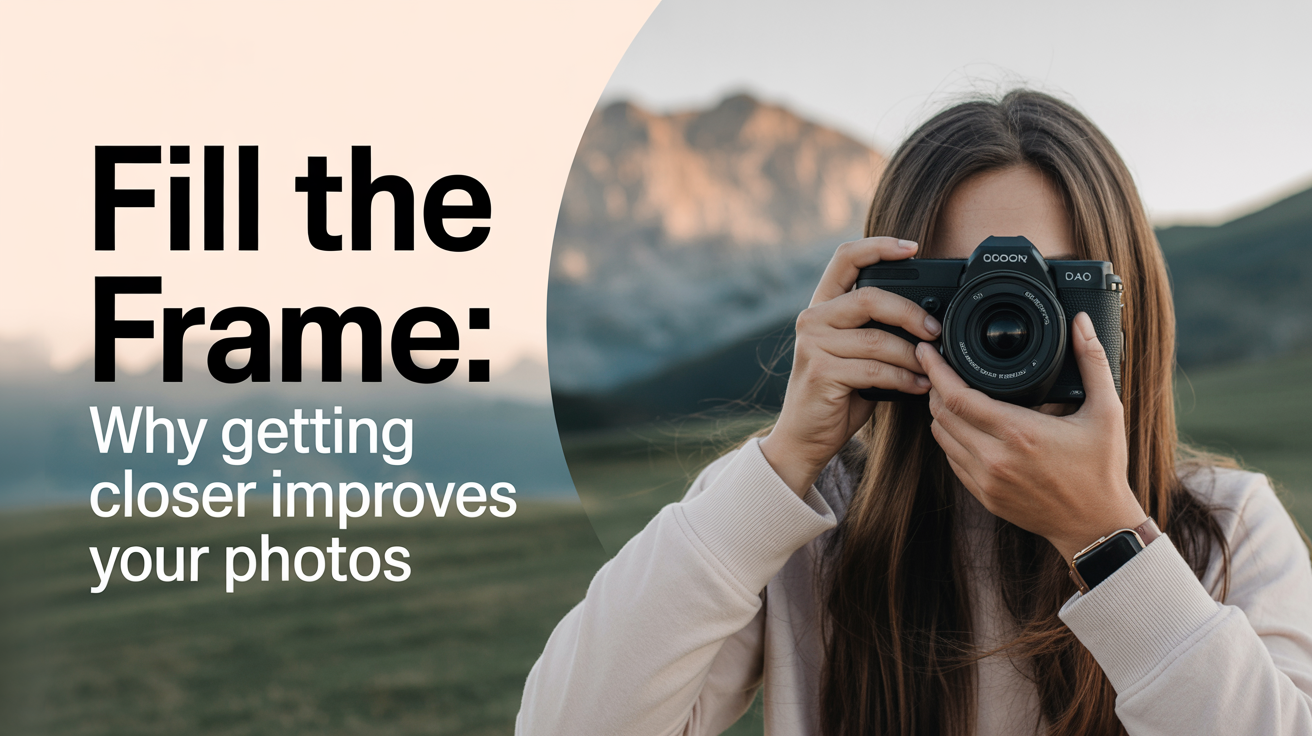
Most beginners shoot from wherever they happen to be standing. The subject ends up small, surrounded by a busy background, and the photo feels a little flat. One of the fastest fixes is also the simplest: get closer. Filling the frame means letting your subject take up most of the image, with little or no empty space around it. The result is more energy, more detail, and a much clearer message about what the photo is actually about.
Why Small Subjects Weaken a Shot
When your subject is tiny in the frame, the viewer's eye doesn't know where to go. It roams around the image looking for an anchor. A cluttered background competes for attention, and if the background wins, the subject loses.
Think about a portrait where the person's face fills only a quarter of the frame. You see chairs, a door, a lamp, someone else walking by. The face is there, but it's not the undeniable centre of the image. Now imagine that same face taking up the full frame. Suddenly the freckles, the catch-light in the eyes, the slight smile at the corner of the mouth, all of that becomes the photograph. Nothing competes.
The same principle applies to flowers, food, animals, architecture details, and almost any other subject. Proximity creates intimacy and removes the noise that dilutes impact.
Moving Your Feet vs. Zooming In
You have two basic ways to fill the frame: walk closer, or zoom in with your lens. These are not the same thing, and the choice matters.
Moving your feet changes your physical relationship to the subject. It shifts perspective, alters the angle, and affects how background elements relate to the foreground. When you step closer to a flower, for example, the background blurs more dramatically because the distance between you, the flower, and what's behind it has changed. You also tend to find slightly different angles when you actually move.
Zooming in compresses that perspective. A long focal length flattens the scene and brings distant backgrounds closer relative to the subject. This is useful when you physically cannot get closer (a bird on a far branch, a player on a sports field), but it doesn't give you the same intimacy as physically closing the distance.
For most beginners shooting with a kit lens or a smartphone, the best habit is to move your feet first, then adjust with zoom if needed. Physically getting closer often reveals details and angles you would never have found from far away.
How to Fill the Frame: Step-by-Step
-
Identify the core subject. Before you raise the camera, decide what the single most important element is. One face, one flower, one texture, one detail.
-
Move toward it. Walk closer than feels natural. Most beginners stop too early. If you think you're close enough, take one or two more steps and check again.
-
Check the edges. Look at all four sides of your viewfinder or screen. Are there distracting objects creeping in from the corners? Reposition or crop them out.
-
Decide what to include and what to cut. You don't have to show all of something. A portrait can be cropped below the chin. A flower can bleed off the edges. Partial subjects often look more dynamic than the whole thing centered with space around it.
-
Try different distances. Take three shots: one at your instinctive distance, one closer, one even closer. Compare them. You'll quickly see the point where the image tightens up.
-
Check focus. The closer you get, the shallower your focus plane becomes. Make sure the most important part of your subject (eyes in a portrait, stamen in a flower) is sharp.
When NOT to Fill the Frame
Filling the frame is a strong compositional move, but it isn't always the right one. Knowing when to pull back is just as useful.
When environment matters. A portrait of someone in their workshop tells a different story than a tight headshot. If the surroundings are part of the meaning, you need space to show them.
When scale is the point. A tiny figure against a vast mountain range only works if you can see both. Filling the frame with the person removes the contrast that makes the image interesting.
When negative space creates mood. Sometimes empty sky, still water, or an uncluttered floor around your subject creates a sense of calm or isolation that a tight crop would destroy.
When the shape of the whole subject matters. A full-length portrait, a complete piece of furniture, an entire vehicle: some subjects need their full silhouette to be understood.
The skill is reading each situation and choosing deliberately, not just defaulting to one approach. Filling the frame is a tool, and like any tool, its value depends on context.
Practical Exercises to Build the Habit
These exercises work with any camera, including a smartphone.
- The fruit bowl drill. Pick one piece of fruit. Photograph it from your normal standing distance, then take five more shots getting progressively closer. Compare the results. Notice when background distractions disappear.
- Portrait pairs. Photograph a friend or family member twice: once with their full body visible, once with only their face filling the frame. Show them both photos. Ask which one feels more like a real portrait.
- One texture, many distances. Find a textured surface (brick wall, wood grain, fabric). Start far away and take a shot every few steps as you close in. Watch how the texture goes from "background noise" to the main subject.
- The 50% rule. For one photo session, challenge yourself so the subject fills at least 50% of the frame in every shot. It will feel uncomfortable at first. That discomfort usually means you're learning something.
Once you're comfortable filling the frame, look at how it works alongside other techniques. The rule of thirds still applies when your subject is close: a tight portrait face placed slightly off-center often feels more natural than one centered in the frame. You can also combine close-up composition with leading lines when they exist within the close-up itself (a furrow of wrinkles, a row of stitches, the veins of a leaf). And if you want to add depth even in a tight shot, natural frames can work at close range too, using out-of-focus foreground elements to border a face or flower.
Frequently Asked Questions
Do I need a macro lens to fill the frame with small subjects? No. A macro lens is useful for extreme close-ups of very small subjects like insects or coins, but most filling-the-frame work (portraits, flowers, food, details) doesn't require one. A standard kit lens or a smartphone with portrait mode will get you close enough for most situations. Just be aware of your lens's minimum focus distance and don't push past it, or you'll get a blurry image regardless of how close you are.
Is filling the frame the same as cropping in post-processing? Not quite. Cropping in editing is a useful last step, but it throws away pixels and can reduce image quality if you crop heavily. Getting closer in-camera gives you more resolution and forces you to think about composition before you shoot, which generally produces better results. Use in-camera filling as the main technique; editing crops are for small adjustments.
My photos look sharp on the camera screen but blurry when I zoom in. Why? When you get close to a subject, the depth of field (the zone of sharp focus) becomes very shallow. Even a small movement forward or back can shift what's in focus. Make sure you're tapping to focus on the right part of the subject, and consider using a slightly faster shutter speed if you're hand-holding, since any camera shake is magnified at close range.
Can I fill the frame when photographing groups of people? Yes. A tight group shot where faces fill the frame can be very engaging. The challenge is making sure everyone is on roughly the same focus plane, so they're all sharp. Ask everyone to lean in close together rather than standing in rows, and focus on the eyes closest to the camera.
How close is too close? When the image becomes unrecognizable or uncomfortable. A face filling the frame is striking. A single pore filling the frame is abstract. There's no fixed rule, but if viewers can't tell what they're looking at without context, you've probably gone past filling the frame and into pure texture or detail territory. That can be intentional and interesting, but it's a different kind of photograph.