Gear Guides
DSLR vs Mirrorless: Which Should a Beginner Buy?
DSLR or mirrorless? We break down the real differences so a beginner can pick the right camera without overspending or overthinking it.
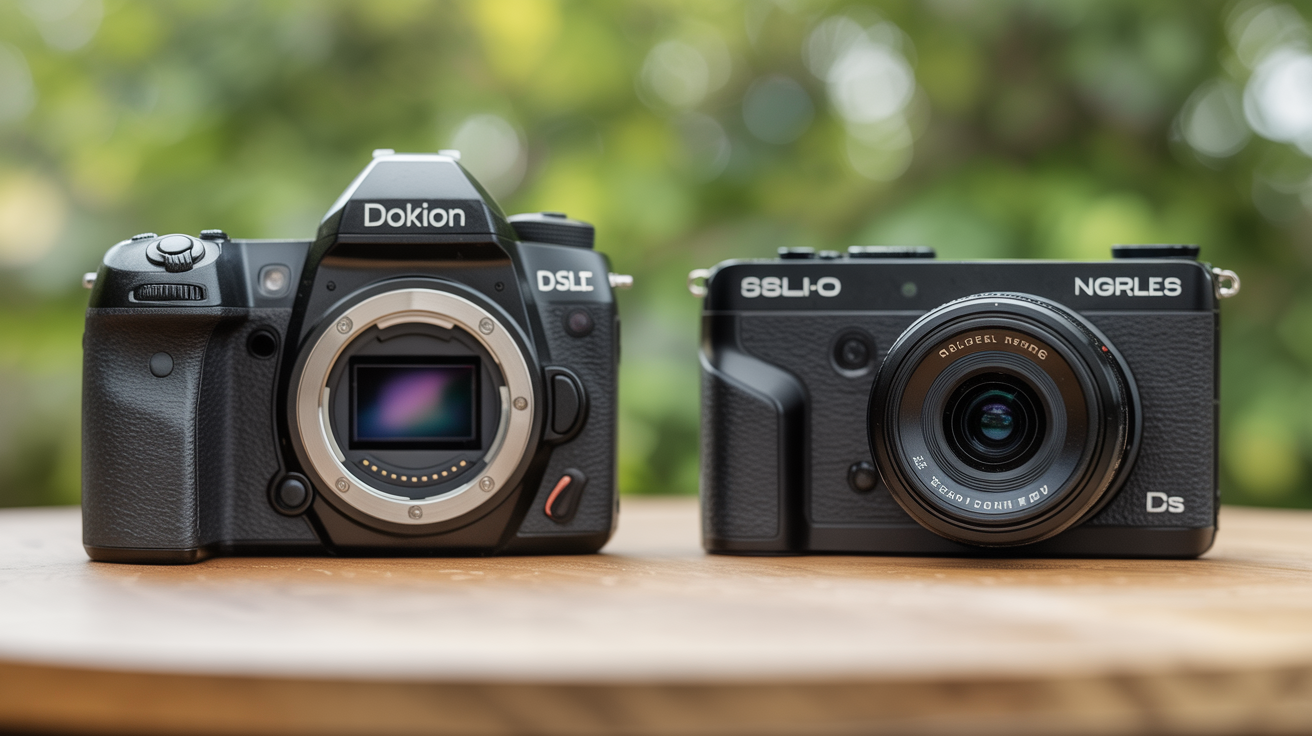
You've decided to buy a real camera. Then you hit the first big question: DSLR or mirrorless? It sounds technical, but the difference comes down to one small piece of hardware. Understanding that piece makes the whole decision much easier.
Both types shoot great photos. For a beginner, the gap between them is smaller than the marketing copy suggests. What follows is an honest breakdown of how each works, where each wins, and how to decide without second-guessing yourself for weeks.
How Each Camera Works
A DSLR (Digital Single-Lens Reflex) has a physical mirror inside the body. When you look through the viewfinder, you're seeing light that bounced off that mirror and passed through a prism to your eye. It's an optical view of the actual scene, live and lag-free. When you press the shutter, the mirror flips up, the shutter opens, and light hits the sensor.
A mirrorless camera removes the mirror entirely. Light goes straight to the sensor all the time. Instead of an optical viewfinder, you look at a tiny electronic screen called an EVF (electronic viewfinder) that shows a digital preview of what the sensor is seeing. Some budget mirrorless models skip the EVF and rely only on the rear screen.
That's it. One has a mirror; the other doesn't. Everything else flows from that.
The Real Tradeoffs
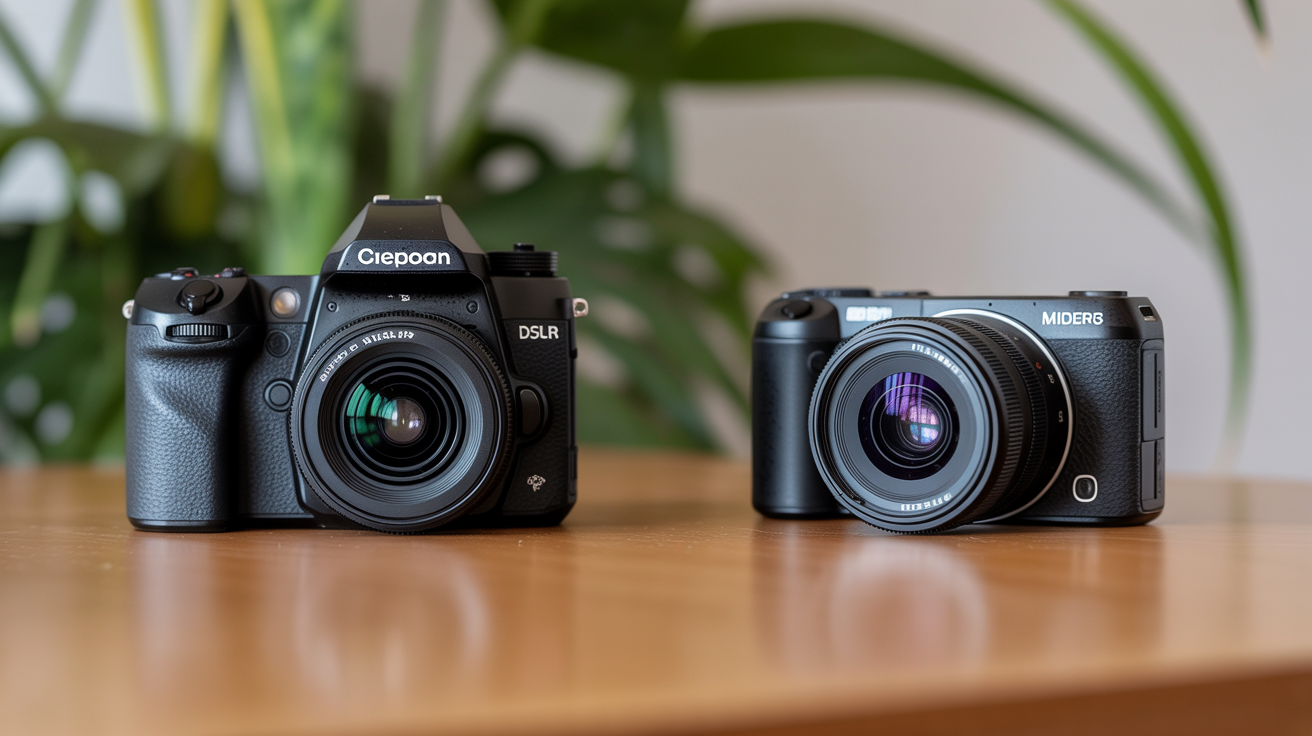
Size and Weight
Without a mirror box and prism, mirrorless bodies can be considerably smaller and lighter. A full-featured mirrorless camera can feel close to a point-and-shoot compared to a chunky DSLR. This matters more than people expect. A camera you'll actually carry beats a "better" camera sitting on a shelf.
That said, compact mirrorless bodies sometimes need larger lenses to balance out, so the system weight evens out once you add glass. Check the full kit weight, not just the body.
The Viewfinder Experience
The optical viewfinder on a DSLR shows you the real world with zero lag. It's clear, bright, and works even when the battery is dying. Many photographers love this for feeling connected to the shot.
The EVF on a mirrorless camera shows a digital simulation of the exposure. That's actually a major practical advantage: you can see in real time whether the image will be too dark or too bright before you press the shutter. It's like a live preview of the final photo. For beginners still learning exposure, this feedback loop is genuinely useful. The downside is that cheap EVFs can look grainy or laggy in dim light, though mid-range and higher mirrorless cameras have solved this almost entirely.
Autofocus
This is where mirrorless has pulled clearly ahead. Modern mirrorless cameras use on-sensor phase detection across the entire frame, paired with subject-tracking that can lock onto eyes, faces, or moving objects with impressive accuracy. Entry-level mirrorless autofocus today outperforms what flagship DSLRs cost twice as much to do five years ago.
DSLRs use a separate autofocus sensor (active only when the mirror is down and you're using the optical viewfinder). In live-view mode, where you shoot using the rear screen, DSLR autofocus is noticeably slower. If you ever shoot video on a DSLR, this becomes a real frustration.
Battery Life
DSLRs win here, and it's not close. Because the optical viewfinder doesn't need power, a DSLR can take 800 to 1,000+ shots on a single charge. Mirrorless cameras power the sensor continuously to feed the EVF, cutting that number to 300 to 500 shots on many models. You can manage this by carrying a spare battery (they're cheap), but it's worth knowing upfront.
Lens Selection
This one matters more for long-term ownership than for a first purchase.
DSLRs, particularly those from Canon and Nikon, have decades of lenses in their ecosystems. You can find used DSLR lenses at almost every price point, including exceptional glass for well under $200. If budget is tight, this used-lens ecosystem is a genuine advantage.
Mirrorless systems are newer, so native lens libraries are smaller, and used prices are still high. The major manufacturers (Sony, Fujifilm, Canon, Nikon) are investing heavily in their mirrorless lines, and adapters let you mount older lenses with some limitations. But if you want a wide native selection at low prices right now, DSLR wins.
For most beginners, this matters less than it sounds because you'll likely start with the kit lens and maybe one or two more. See Camera Lenses Explained: Prime vs Zoom for a practical guide to what to buy next.
Price
At the entry level, DSLRs are often cheaper for the body, especially used. A used crop-sensor DSLR with a kit lens can be had for $200 to $350, which is hard to beat for getting started. Entry mirrorless bodies start around $500 to $700 new, though prices drop quickly on slightly older models.
The industry is moving to mirrorless. Canon and Nikon have both confirmed they're winding down DSLR development and focusing their R&D on mirrorless. That means DSLR prices will keep dropping (great for buyers), but new DSLR lenses and accessories will be fewer and farther between over time.
Side-by-Side Comparison
| Factor | DSLR | Mirrorless |
|---|---|---|
| Size and weight | Larger, heavier | Smaller, lighter (bodies) |
| Viewfinder | Optical, real-world view | Electronic, shows exposure preview |
| Autofocus | Strong (optical VF); slow in live view | Excellent across the frame |
| Battery life | 800 to 1,000+ shots | 300 to 500 shots |
| Video autofocus | Poor in live view | Very good to excellent |
| Used lens availability | Enormous, affordable | Growing, still pricier |
| Entry price (body) | Lower, especially used | Higher, but dropping |
| Industry direction | Being phased out | Current and future focus |
The Honest Beginner Take
If you want the most camera for the least money right now, a used DSLR is hard to argue with. The images are excellent, the handling is solid, and the used ecosystem lets you add quality lenses without spending a lot. You will not be limited by the camera for years.
If you want a system you can grow into without switching later, mirrorless makes more sense. The autofocus is better, the live exposure preview helps while you're learning, and the industry's future is clearly here. Paying a bit more now avoids a migration later.
Either way, here is the most important thing: the lens matters more than the body. A decent 50mm prime on a budget DSLR will outperform an expensive kit zoom in almost every low-light situation. Once you have a body you're comfortable with, look at something like The Nifty Fifty as your first lens upgrade.
If you're still deciding which camera body to buy specifically, our broader guide to How to Choose Your First Camera walks through sensor size, brand ecosystems, and what to look for in specs without drowning in numbers.
Frequently Asked Questions
Is mirrorless better than DSLR for beginners?
Not automatically. Mirrorless has better autofocus and a live exposure preview that helps while you're learning, but DSLRs cost less (especially used) and have a massive lens library. Either type will teach you photography just as well.
Will DSLRs become obsolete?
Eventually, yes. The major camera makers have shifted their development focus to mirrorless, so new DSLR models and lenses are becoming rare. DSLRs will work fine for many years, but if you're buying new with a long-term view, mirrorless is the direction the market is heading.
Do mirrorless cameras drain battery faster?
Yes. Because the sensor powers the electronic viewfinder continuously, mirrorless cameras typically get 300 to 500 shots per charge vs 800 or more for a DSLR. Carrying one or two spare batteries (which are inexpensive) solves this in practice.
Can I use DSLR lenses on a mirrorless camera?
Usually yes, with an adapter. Canon, Nikon, and third-party adapters exist for most combinations. Autofocus usually works, though not always as fast as native lenses. The adapter adds length and cost, so it's worth researching your specific camera and lens pairing before counting on it.
Should I buy a mirrorless camera without a viewfinder to save money?
Only if you're comfortable shooting entirely from the rear screen. A viewfinder, optical or electronic, helps in bright sunlight and gives steadier handheld shots because you brace the camera against your face. If the budget is very tight, a viewfinder-less model works, but try to move up to one with an EVF when you can.